Overview#
TabStruct provides two experiment pipelines: prediction for classification and regression, and generation for synthetic tables and their evaluation. The shared runtime fixes seeds, prepares data, selects a registered model, and records metrics and artifacts.
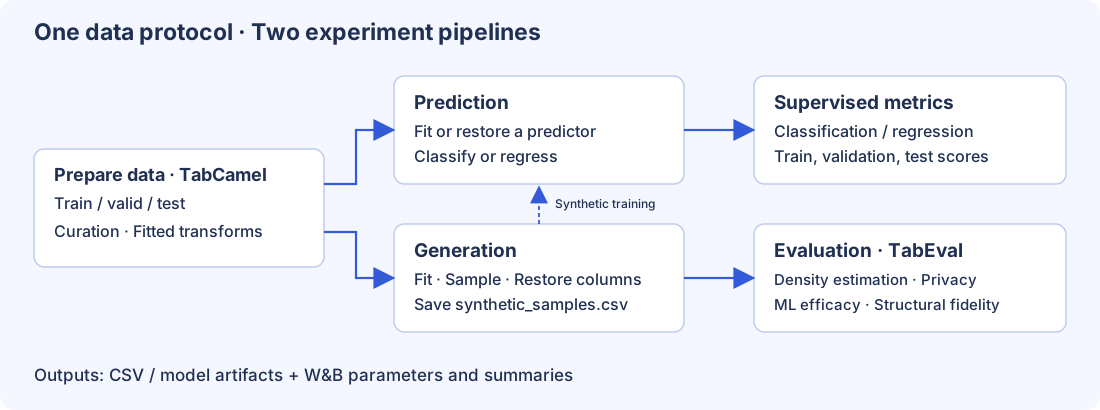
This diagram describes the current implementation rather than a neural network architecture.#
Key components#
Module under |
Responsibility |
|---|---|
|
CLI and Python experiment entry point. |
|
Argument parsing, interactions, seed and device setup. |
|
TabCamel loading, splits, curation, preprocessing, and |
|
Shared model lifecycle, helper orchestration, and pickle persistence. |
|
Predictor adapters and supervised metric computation. |
|
Generator adapters, synthetic CSV output, and TabEval integration. |
|
Selects the generation or prediction helper. |
|
Optuna parameter search over repeated splits. |
Data lifecycle#
DataHelper loads a named dataset through TabCamel, removes constant
features, splits test rows first and validation rows second, then applies
optional training-data curation. Feature and target transforms are fitted
using training data and applied to the other splits. DataModule exposes
DataFrames, array views, and Lightning dataloaders.
For generation, synthetic samples are restored to the original column space before CSV export. Evaluation constructs its own original, one-hot, and ordinal views; it does not reuse a generator’s private encoding as the metric space.
Metrics#
TabStruct considers four dimensions: density estimation, privacy preservation, ML efficacy, and structural fidelity. TabEval supplies the synthetic-data evaluators. The prediction pipeline measures ML efficacy when its training split is replaced with synthetic rows.
The paper calls the structural metric global utility; the current runner
dispatches structural evaluation through TabEval’s UtilityPerFeature class.
See Evaluation for the configured evaluators and split policy.
W&B#
W&B entity/project constants live in src/tabstruct/common/__init__.py.
Local data and model artifacts are saved under logs/<configured-project>/;
W&B stores the corresponding paths in run summaries. A path recorded online
still needs to exist on the machine restoring or evaluating the artifact.
The Models Reference registry describes the current checkout. Reproducing a paper result also requires its dataset, evaluation settings, predictor ensemble, and aggregation protocol.