TabStruct Documentation#
Choose a workflow#
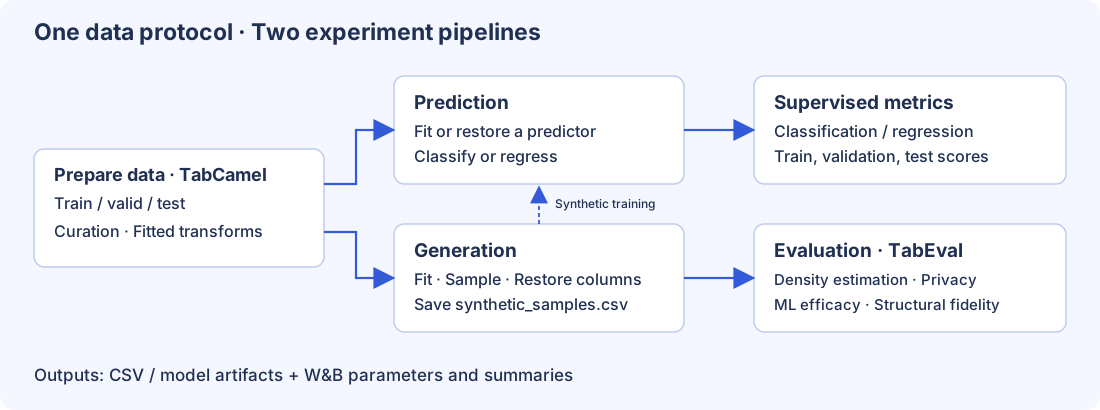
Generate a table
Create synthetic tables with the original feature and target schema.
Compare generators for a research data-sharing workflow.
Generator API Generation tutorial
Evaluate synthetic data
Assess density, privacy, ML efficacy, and structural fidelity.
Check whether a synthetic table retains relationships across columns.
TabEval integration Evaluation guide
Benchmark a predictor
Train classifiers or regressors and compare held-out performance.
Establish a credit classification baseline and restore its checkpoint.
Predictor API Prediction tutorial
First run#
After installation and W&B setup, run from the repository root:
python -m src.tabstruct.experiment.run_experiment \
  --pipeline prediction \
  --task classification \
  --model lr \
  --dataset credit-g \
  --device cpu \
  --save_model \
  --tags tutorial-prediction
The runner returns split-specific metrics and records best_model_path
when saving a model. Continue with the tutorials or
browse the model registry.
Citations#
@inproceedings{jiang2026tabstruct,
  title={TabStruct: Measuring Structural Fidelity of Tabular Data},
  author={Jiang, Xiangjian and Simidjievski, Nikola and Jamnik, Mateja},
  booktitle={The Fourteenth International Conference on Learning Representations},
  year={2026}
}

@inproceedings{jiang2025well,
  title={How Well Does Your Tabular Generator Learn the Structure of Tabular Data?},
  author={Jiang, Xiangjian and Simidjievski, Nikola and Jamnik, Mateja},
  booktitle={ICLR 2025 Workshop on Deep Generative Models in Machine Learning: Theory, Principle and Efficacy},
  year={2025}
}